Wednesday, August 23, 2006

Trip Story: Porangahau

The stated purpose of our visit to Porangahau was to allow me to sample the "traditional New Zealand beach holiday." Apparently, many New Zealand families spend a week or two in a small beach town every year. I had been told about how relaxing this was, and was looking forward to experiencing it for myself. In theory, Porangahau was an excellent place to do this- it is a small town far away from the big city and has a big sandy beach. In practice, it had some flaws: no dairy (the New Zealand term for a small corner shop, which was to be our source of the ice creams I'd been told we would eat daily) and no bakery (which was to be the source of our daily meat pie lunch). In their place, there was a tackle shop that also sold the afore mentioned essentials as well as the equally essential bottles of beer. The pies were mass-produced frozen things that were reheated in a microwave and/or pie warmer and the ice cream selection was limited to prepackaged bars and cups. Neither the pies nor the ice-cream were bad, but they didn't quite live up to be pre-trip hype.

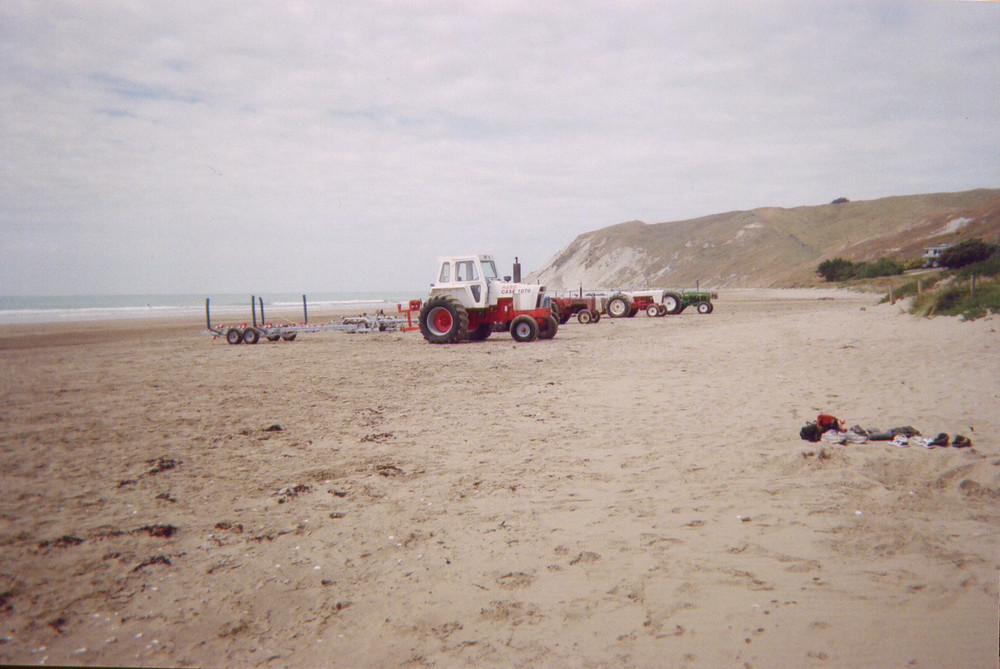
The other problem with Porangahau was the weather. It turns out that "Porangahau" roughly translates to "a big wind" (at least according to Hubby's aunt, who lives there). It certainly lived up to its name. This meant that it was usually too cold for me to consider going into the water, and often too cold for me to sit on the beach without long sleeves. To be fair, we were there a little before summer truly hit, and it is definitely a beautiful beach- long, wide, and mostly empty. You could easily find a swath to call your own and avoid any worries about anyone overhearing your conversation (not that this is usually a big worry in New Zealand; see the previous post). We did, however, have to worry about being run over by kids on bikes, both the motorized and pedal powered variety. Apparently, the large stretches of mostly empty sand are too tempting to resist. The bike-riding kids made me nervous, but we never saw anyone get run over. At least we didn't have to contend with the larger version of these toys, i.e., the tractors the locals use to tow their boats into and out of the surf. The fishermen went out long before we made it to the beach, and came back in well after we had packed up for the day. I could see the practicality of using large-wheeled tractors to tow the boats across the sand, but I still found the sight of a row of tractors parked on the beach pretty funny.

I spent quite a bit of time one day standing in the shallow water, watching little fish swim around my ankles. There were at least three different varieties, but all suffered from the same tendency to get caught by surprise when a wave receded, causing them to suddenly swim like mad back toward the deeper water, occasionally jumping out of the water in their haste. I found this hugely entertaining to watch. At one point, while chasing after the panicked fish, I realized I had gotten the true New Zealand beach holiday experience despite the sub-standard pies and limited ice cream selection. The most essential part of the New Zealand beach holiday is the long stretch of days with nothing much to do except sit on the beach, walk on the beach, or, in my case, stand in the water and watch little fish get surprised by the way receding waves make the water suddenly get shallower. Our trip to Porangahau had been a success.

Sunday, August 06, 2006

Frame Shift: New Zealand

No matter how often I travel, somehow I am always surprised by the mix of familiar and foreign I experience when visiting another English speaking nation. In "Pattern Recognition", William Gibson calls this same but different phenomenon "mirror world ". I think of it more as a frame shift- we are all working from the same cultural genome, but are transcribing it differently. Sometimes, the shift is minimal (parking lot becomes car park). Other times, it is more profound (self confidence becomes arrogance). Together, all of the shifts remind me that while I can speak the language and understand the more fundamental cultural assumptions, this is not home, and I am a stranger here.

Given a number of times I've visited New Zealand, and the fact that I live with a New Zealander, you might think that New Zealand would no longer have this effect on me, but it does. I have not lost the feeling of frame shift, but I am losing the ability to name the differences that cause the feeling, since they are becoming so familiar to me. Before I lose them all together, I'll write some of them here.

1. It is not until you travel that you truly appreciate how accustomed you are to a particular type of toilet. Even in countries with largely similar toilet preferences, the differences between the strange new facilities and those you are used to back home are immediately apparent. In fact, given the length of the flight you probably endured to reach the new country, these may be some of the first differences you notice. There are two principal differences between American toilets and New Zealand ones. First of all, the doors on public toilets are different. Except in the fanciest of hotels and restaurants, American public toilet stalls have a gap of at least a foot between the door and the floor, and usually a small gap between the side of the stall and the door as well. I have heard that these gaps can be quite disconcerting to visitors used to the more sturdy doors found on New Zealand toilets. New Zealand public toilet stalls almost always have a full door, similar to the bathroom door in your home. This prevents you from using the American trick of peering under the stall door to ascertain if the stall is empty. The New Zealanders provide a much more civilized method of determining this: the lock on the door is connected to a sign on the outside of the door that indicates whether the stall is vacant or occupied (similar to the door lock on an airplane toilet).

The differences don't end at the door. The toilet itself is different, because, instead of a familiar single handle with which to flush the toliet, you are presented with two buttons. After some experimentation and a bit of discreet questioning, I learned that these are for the full and half flush, the half flush being a rather obvious water saving feature once you think about it.

2. Another thing I never thought much about before traveling is roofing material. Many New Zealand homes have corrugated iron roofs, something which is not common in my part of the United States. The only California homes with metal roofs also have wheels. My husband was surprised by my surprise at this choice of roofing material, because it is extremely common in New Zealand, and certainly not limited to any particular level of housing.

3. You don't expect to have trouble communicating in a country that speaks the same language you do. Sure, there might be some amusing differences in word choice (let's just say you shouldn't call that bag around your waist a "fanny pack" anywhere outside of the U.S.), but by and large, you expect to be able to have friendly conversations with the locals. This is true, but there are surprising differences in conversational style that can quickly make the traveler feel like a rude tourist. Anyone who has traveled at all outside the United States has probably noticed that Americans are a relatively loud nationality. Conversations that would be lost in the hubub at home reverberate through the entire restaurant abroad. If I could give only one piece of advice to an American setting out on his or her first trip abroad and wanting to avoid offending the natives it would be "shhhh". Whatever you want to say, chances are, the person on the other side of the room doesn't want to hear it. Unless you are alerting everyone to a fire, lower your volume by a few notches.

Kiwis are as quiet as we are loud. When in New Zealand, I often find myself straining to hear the person seated next to me, and have embarrassed myself many times by smiling and nodding when a more expressive response was expected. I sometimes think New Zealand is a nation of lip readers, because New Zealanders have an extraordinary ability to hold sotto voce conversations in noisy pubs. I find my normal speaking voice far too loud for New Zealand, and when I return from a trip there my American friends must constantly ask me to repeat myself.

New Zealanders also do not talk over each other. It was only when I began to hang out with a lot of Kiwis that I realized how often Americans do this. No one thinks anything of a group of friends in which two or three are speaking at the same time. In New Zealand, this almost never happens. I spend my time in New Zealand biting my tongue, waiting for my turn to whisper some contribution to the conversation. New Zealanders in America, have it far worse. They never get a word in edgewise, and when they do, half of the group doesn't hear them!

There are far more differences than I have listed here, but I don't want to deprive you of the chance to discover some of the frame shifts on your own. New Zealand is a wonderful place to visit. Just keep your voice down, and be careful to choose the correct button when flushing the toilet.

Monday, July 24, 2006

Mt. Bruce Bird Sanctuary

I had been living with a Kiwi for four and a half years before I finally caught sight of his avian namesake. It probably says something about the national consciousness of New Zealanders that they chose a nocturnal, flightless bird as their national symbol. I think it has something to do with their love of the underdog- this is a country that manages to spin its rugby team as the underdog in most contests, despite the fact that the All-Blacks are currently ranked number one and are almost always ranked in the top three. The kiwi bird is definitely an underdog. It is singularly ill-adapted to compete with the mammals man has introduced to its native habitat: it can't fly, doesn't see well, and produces a large (and presumably tasty) egg that is up to 25% of the mother's weight. Still, the kiwi has not gone extinct. It is on the endangered list, but fights on, and, thanks to the help of the human Kiwis, has even made a comeback in some areas.

This is not to say that the kiwis are plentiful enough that you can hope to see them in the wild on the main New Zealand islands. They are still a rarity. Therefore, my first bona fide kiwi sighting came in a kiwi house, which is an enclosure that is kept dark so that the kiwis' internal clocks are reversed and visitors can see the nocturnal kiwis during the day. I did not enter this kiwi house with much hope: I had been in many other similar enclosures before, and never had any luck in spotting a kiwi. However, this time I was in luck. I saw not one, but two kiwis. They are extremely unbirdlike, and also a bit comical. Their vestigial wings are completely hidden under their shaggy brown "fur", which is of course actually feathers. They do have a beak- a long, thin thing they use to forage for grubs and other insects- but it is also rather unbirdlike, in that it has nostrils on the end of it, which allow the kiwi to sniff out food. In other birds, the nostrils are at the top of the beak. The kiwi also has a Monty Pythonesque silly walk. It bobs up on one leg and seems to swing the other leg forward. Still, I found the kiwi a bit cute.

Clearly, I was not the only one who thought the kiwi was cute. The male kiwi took a fancy to the female kiwi, and I think we saw kiwi sex. Or perhaps we only witnessed a grooming routine. I am not an ornithologist, and my web searches on the subject have done little more than demonstrate that there are porn sites dedicated to New Zealanders. Anyway, one of the kiwis (presumably the male) hopped on top of the other, who seemed completely unperturbed by this and continued foraging for food. A short while late, the other kiwi hopped back off, and resumed foraging, too. If this is indeed their mating routine, the fact that their eggs and young are a favorite food of so many of the introduced mammalian predators might not be the only reason they are on the verge of extinction.

My kiwi encounter took place during a visit to the Mt. Bruce Bird Sanctuary in New Zealand. We had spent Christmas with my in-laws, and were heading to a small beach town to experience a true New Zealand beach holiday. We stopped at the bird sanctuary on our way. In addition to the kiwis, we saw the kakariki (a bright green parrot that is often kept as a pet), the kokako (a bluish-grey bird with a bright blue throat), and the kaka. The kakas were my second favorite birds (after the kiwis, of course). They are not brightly colored, but they are still a lot of fun to watch. They have a strong beak, which they use to crack open tree cones to extract the seeds. They also use their beak a bit like a third leg. We watched them maneuver around the chain link fence separating their area from the wild by biting a link in the fence in the direction they wanted to go and then swinging their legs around underneath them again. They are quite adept at this, and could move along very quickly.

All of these birds are endangered in the wild, because they have not fared well in competition with the mammals man has introduced to New Zealand. Before the Maori arrived in ~1000 C.E., the only mammals on the islands were two species of small bats. The Maori brought the dog and the rat. The Europeans later brought cats, stoats, possums, and more dogs and rats. These introduced species compete with the native birds for habitat and in some cases eat the birds. For instance, the kiwi chicks are particularly vulnerable to predation, and it is estimated that stoats and cats kill 95% of kiwi hatchlings each year (see the NZ Department of Conservation website). New Zealand is now fighting hard to protect the kiwi and its other native birds. They have set up bird sanctuaries on some of the smaller islands, after painstakingly eliminating all non-native animals. The difficulty of this effort is underscored by a recent experiment performed with a single male rat. "Razza" was fitted with a radio collar and released on an uninhabited island. He settled in, and then managed to elude all attempts to recapture him for the next eighteen weeks. In fact, at some point around week ten, he showed up on a neighboring, previously rat-free island, swimming across ~1300 feet of open ocean to get there. The native New Zealand birds are indeed up against some stiff competition.

Thursday, July 20, 2006

Trip Story: Easter Island

I expected Easter Island to be one of the highlights of our big trip, and I wasn't disappointed. From the moment we boarded the plane, I felt like a lucky member of a privileged group, and I suspect quite a few of the other passengers felt the same way. Certainly, there seemed to be a larger than usual interest in the view from the plane windows as we touched down.

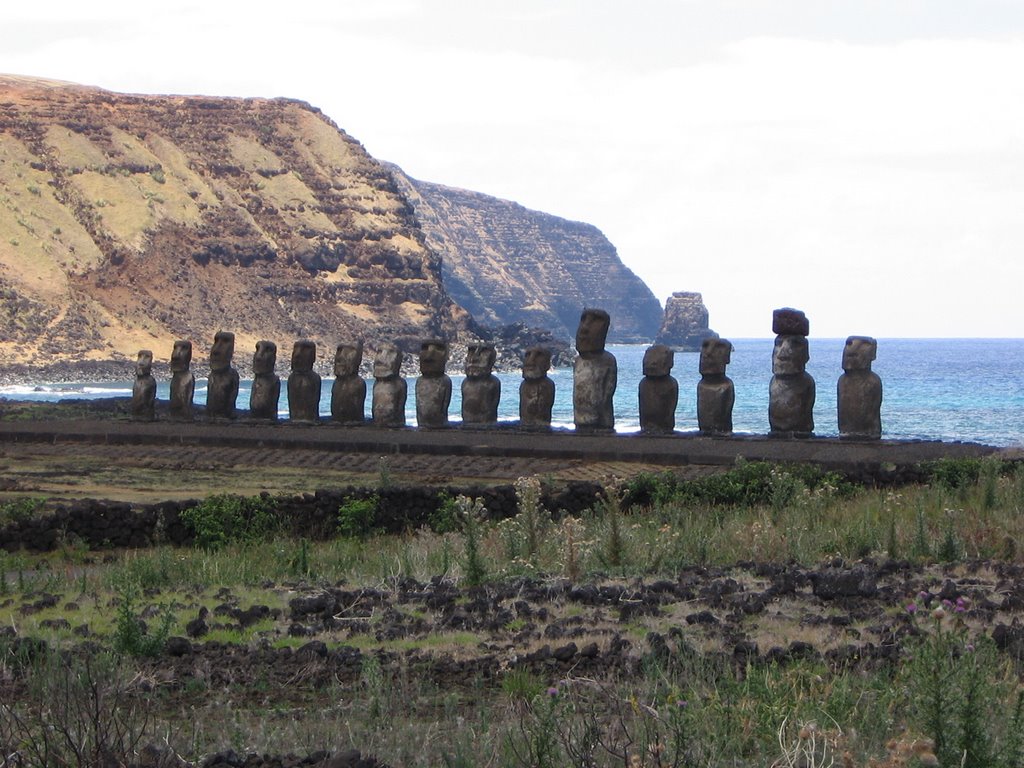
What makes Easter Island so special? The obvious answer is the moai, the giant stone statues with exaggerated heads that some believe consumed so many of the island's limited resources that the ancient Islanders nearly perished. These are indeed magnificent, but there are other reasons the island is a special place. It is one of the most isolated places on earth, and receives far fewer visitors than its spectacular history and beautiful scenery would draw in a more easily reached locale. Despite the relatively few visitors, tourists still outnumber locals. Therefore, it is easy to forget to how isolated the island is-at least until you notice that a can of beer costs the same as a can of soda, which costs the same as a bottle of water. This is because the price of these items as set by transport costs, and they all occupy a similar space in a container ship.
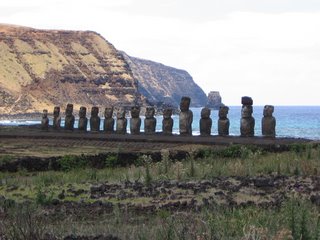
The culture on Easter Island, both current and past, also makes the place special. The current Islanders are warm, friendly, and very welcoming. They never made us feel out of place, even when we turned up at a restaurant only minutes before the high-school graduation dinner guests arrived. We were seated at a prime table, with a view of both the water and the evening's festivities. The high schoolers were as boisterous as you would expect from their age, but were also great fun to watch. It was a small class, with perhaps 30 students, so they all knew each other and, at least for the night, were friends. They talked, laughed, and took quite a few group pictures. We couldn't resist trying to capture a picture of our own, to show the wide range of fashion on display. Most of the boys wore Island print shirts and light colored trousers. The girls' attire, however, ranged from slinky modern dresses to a beautiful island print full length gown. We weren't quick enough with our camera, though, so we'll just have to hope and the memory stays with us.

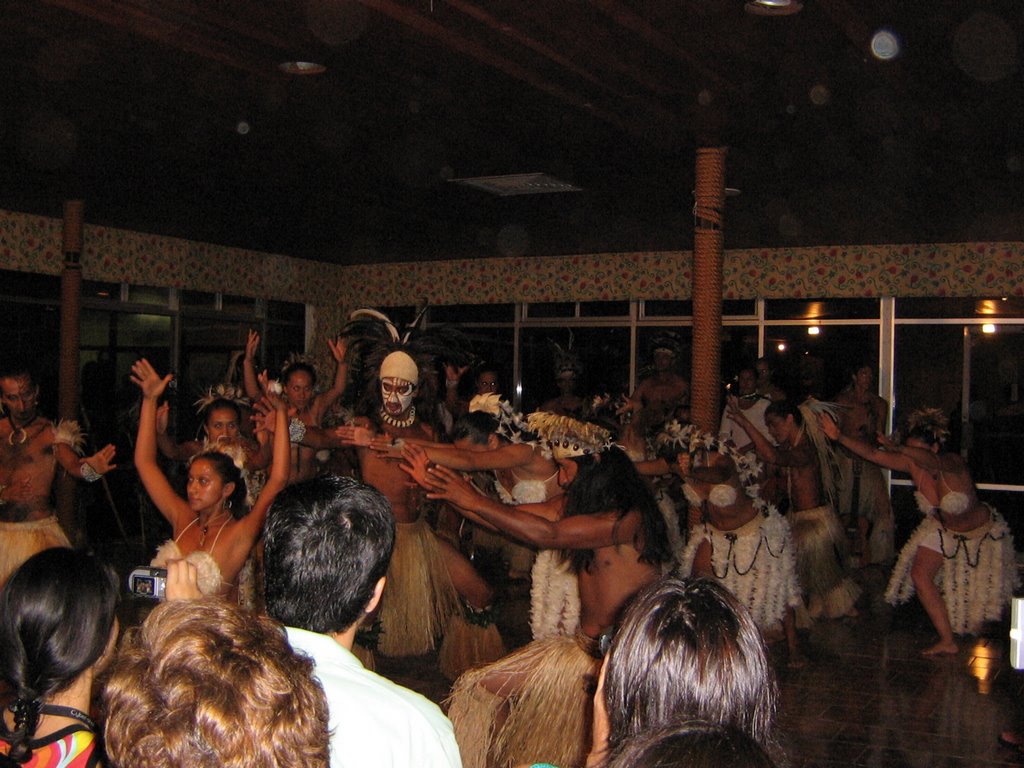
A more conventional cultural highlight was the island dance night we saw. There were certainly similarities to dances we've seen on other Pacific islands, but there were clear differences as well. The costumes used feathers, which we had never seen before. The men's dances involve more leaps and twirls, and the women's dances used a wider stance, which made the characteristic Polynesian hip sway more pronounced and also more gentle. This was also one of the happiest dance troupes we have ever seen, and despite the suboptimal setting the for the show (several rows of chairs around a room, so the only the first row got a clear view), it was one of the most enjoyable shows we've seen.

Another fascinating cultural feature is the way Polynesian culture has been adapted to this island, and blended with the influence from South America. The original Islanders are thought to have come from the Marquesas Islands. They brought various crops with them, but found that the tropical plants did not fare well in the drier subtropical climate. They came up with an ingenious solution to this problem. They built short circular stone walls, a bit like above ground wells, which concentrated the humidity and allowed their crops to grow. The South American influence is prevasive, but subtle. It is most obvious in the restaurants, many of which serve empanadas and other non native foods. The provenance of the ceviche is less clear, given its strong resemblance to the raw fish dishes found in Polynesia, such as Tahitian poisson cru and the Cook Islands' ika mata.

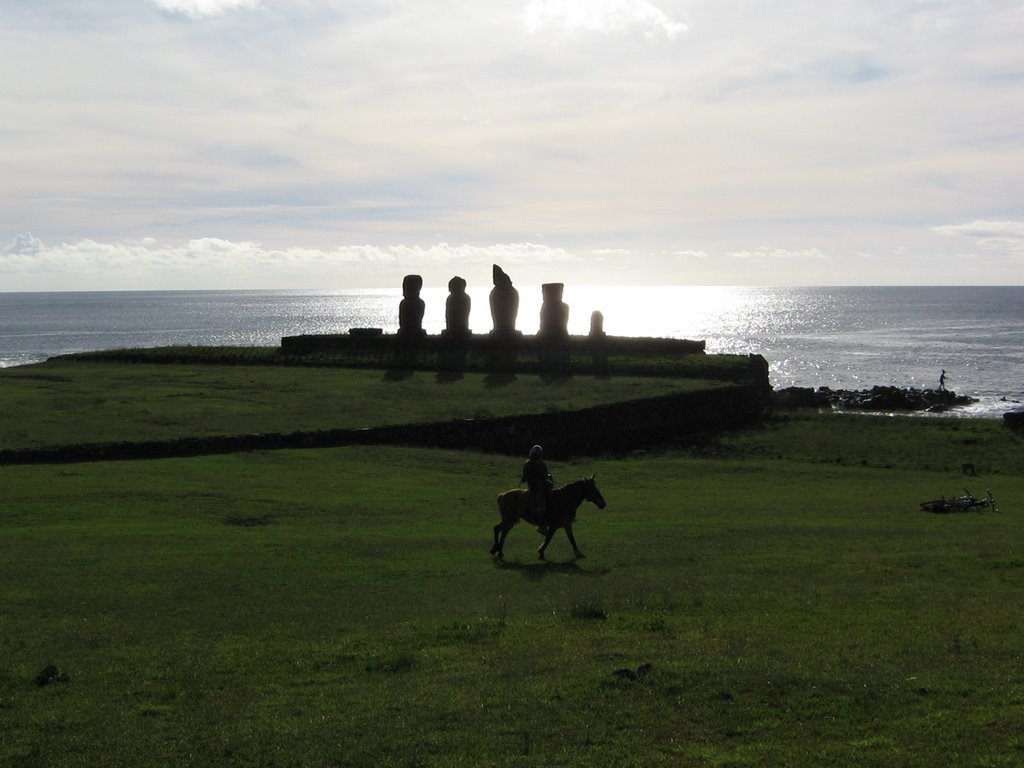
The natural beauty of Easter Island also contributes to the feeling of specialness. If you can forget that the island should have more trees, the rolling grasslands are quite beautiful. The sharp contrast between the flat green ground and the tall stone moai is striking and wonderful, particularly when an Islander riding a horse crosses the scene, as happens not infrequently. However, my favorite natural feature was the color of the surrounding water. It is the usual tropical deep turquoise in the shallower parts near the shore, which in and of itself would be beautiful, particularly since the lack of coral reef means that there are actually turquoise waves crashing on the shoreline. It is the contrast with the deeper water that elevates the scene to the sublime, though, and unlike other islands that have coral reefs to separate the shallow from the deep, the water here transitions from tropical turquoise to a deep indigo blue with no barrier in between. I have never seen water the color of the deep water around Easter Island. It is neither blue nor purple, and the best I can describe it to say that it is roughly the color of the ink in a cheap blue ballpoint pen. This description does not do it justice, and I will forever associate this indescribable color with this island. The water was beautiful from shore, but was even more amazing when we were immersed in it. We went snorkeling on our second day on the island. The snorkeling itself was nothing special. The water was too deep and our snorkeling skills too limited to allow us to see many fish. But the beauty of the water made the trip worth it. My husband also got to see a flying fish during the boat ride to the snorkel spot. I was looking the other way, so only caught a fleeting glimpse, but he saw the fish in full flight, and swears it banked like an airliner.
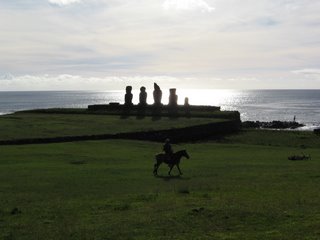
Of course, none of this is the reason most people, myself included, come to Easter Island. The real attractions are the giant stone moai and their cautionary tale about the potential for our deepest beliefs to lead to our destruction. Whether or not the ancient Islanders truly depleted their supply of trees to assist them in moving the moai from the quarry, at which they were carved, to the ahu, or platforms, from which they oversaw their villages, the idea that this might have happened should give all of us pause. The islanders believed that the moai wore their ancestors. Once moved (by a now mysterious method) to the ahu, the moai were given eyes. Once the eyes were in their sockets, the moai was believed to have mana, or power, which protected the village. One can easily imagine how, given this belief, the Islanders would have continued to carve and transport the statues even as they descended into inter- village warfare, most likely caused by competition for scarce resources. As the fighting intensified, the Islanders would have wanted even more of the powerful moai to protect them. Sadly, the moai did not protect them. By the time European explorer stopped at the island, the moai were all toppled (pushed over by rival villagers to destroy their mana) and the Islanders were nearing starvation.

Many people now doubt that the need to transport the moai was the cause of the resource scarcity- overpopulation is more likely. Still, the story lives on, perhaps because of its irresistible resonance with some of the issues facing us now. Whatever the reason for the dwindling supply of trees, it is clear that at some point someone cut down the last tree. It is hard to imagine how that could happen until you visit the island and realize how big it is You cannot see from end to end. Therefore, it seems likely that what happened was that several people independently cut down the last remaining tree in several different locations, each unaware that others were similarly depleting the trees elsewhere. And so otherwise reasonable people brought their culture to the verge of extinction. To me, this is the true message to our times.

Tuesday, July 04, 2006

Our Favorite Gear

Like many people, I find planning for a trip almost as much fun as taking one. Luckily, my husband agrees. It is no surprise, therefore, that we spent a good deal of time researching and choosing the gear to take with us on our big trip. Of course, some of our purchases were more successful than others. Since several people have asked me about this, I decided to post a short list of some of the best gear we took with us.

Best Luggage
We liked our travel packs, but the hands down winners in the best luggage category were the various packing cubes we used to organize our clothing in gear inside of our packs. Eagle Creek makes packing cubes in a variety of sizes, as do some other companies.

Best Clothing
My best clothing find for this trip was the Macabi travel skirt. I searched extensively for a good, versitile travel skirt before eventually settling on this one. I never took advantage of its ability to clip into shorts or pants, but I did love its practical fabric, reasonably flattering fit, and excellent pockets (in addition to deep regular pockets, the skirt has a discrete zippered pocket that I found perfect for my wallet). I bought the long skirt, thinking it would be more appropriate for our time in Muslim Malaysia. I was wrong, but that's another blog entry. If I were to purchase this skirt again, I would definitely buy the regular length. In fact, I may do just that before we take another lengthy trip.

My husband's best clothing purchase for this trip was a pair of Dockers hidden cargo pants. I think they are the Iconic Khaki style, but there is not enough info on the Dockers website to be certain. These pants have a large internal pocket with a zipper, which gave him the ability to carry his wallet or our camera in a secure pocket while still looking moderately formal. They also wore extremely well. He wore them frequently during our four months on the road, and he is still wearing them now that we have returned. This is not just because he doesn't like shopping for new clothes: the pants still look good. We never attempted a truly formal look on this trip, but you can get an idea of how good these pants look by the fact that when he got a new job that requires slightly more formal attire than his previous position (to which he could wear shorts and flip flops), my husband went out and bought another pair of these pants.

Best Medical Kit Component
Given my background in biomedical research, it is probably not a surprise to anyone that we had a variety of antibiotics and other medicines with us on this trip. I did use some doxycycline in China to cure a sinus infection, but most of our fancy medicines thankfully went unused. The oral rehydration salts we had in our medical kit were a godsend, though. We both got a nasty case of food poisoning in the Chiang Mai, Thailand, and were incredibly grateful for the rehydrating and nourishing properties of our oral rehydration salts, and also for the fact that we could get something with these properties without straying far from our toilet. In fact, I was on a diet consisting solely of Sprite and the oral rehydration salts drink (you mix the salts with clean water) for the one day I spent incapacitated from the food poisoning.

Luckily, we only needed the oral rehydration salts once. However, given their low-price and small size, I may never leave home without them again.

Best Gadget
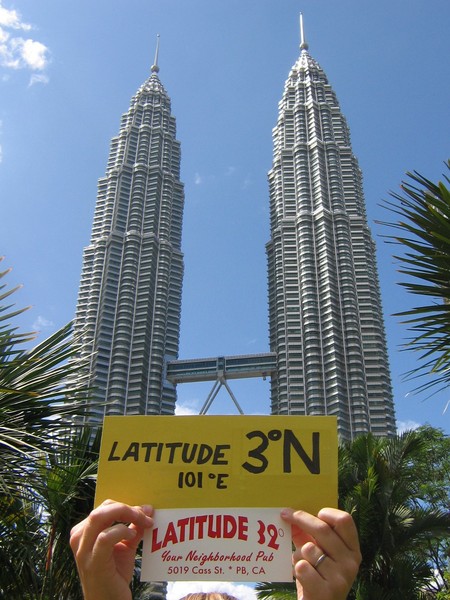
We took my iPod, a handy radio that also served as our alarm clock, and the modern traveler's usual assortment of cameras and phones. Our favorite gadget during the trip, though, was definitely my husband's GPS. We used it at every stop. I wrote our latitude and longitude in my trip log, and we also to take "latitude pictures" such as this one of the Petronas Towers in Kuala Lumpur, Malaysia.


Best Toys
We were packing light, so didn't take many toys. The decision to use some of our precious pack space on our snorkels and masks was definitely a good one, though. Not only were we ensured a perfect fit whenever we went snorkeling, we were also able to have some very cheap days in Thailand. Having our own snorkels with us meant we could spend the day snorkeling for free-and there is some excellent snorkeling in Thailand!