Wednesday, February 07, 2007

Aussie Road Trip: Koala Patting

Australia's unique animals are a big draw for a Northern hemisphere native. Apparently, this attraction is not as strong for people from Southern hemisphere island nations where the only native species are birds. My Kiwi Hubby enjoyed the stranger marsupials at the Sydney zoo, but rolled his eyes whenever I expressed my desire to visit the Billabong Koala Park on our way north from Sydney. The guidebook said that they would let you pat a koala, and once I read that, I knew we had to visit.

Koalas are a big deal in the U.S. It was national news when the San Diego Zoo got its first bunch of koalas, and the koala exhibit still draws sizable crowds despite the fact the star attractions are usually asleep. The koalas we saw at the Sydney zoo seemed more active than the ones I was used to back home. Several were noticeably awake, and one was even swinging from a tree branch. This just whetted my appetite for a closer encounter with a koala. Hubby tried to disuade me by telling me that koalas are drugged out, stupid creatures that eat their own poop. All of this is true, but they are also cute and furry. I was adamant- we were going to the Billabong Koala Park.

We stopped in on the second day of our Aussie Road Trip. We bought wallaby food and chased futily after decidedly non-hungry wallabies, trying to get them to eat from our hands. It was already mid-afternoon, and the wallabies had clearly had enough of their food by this point in the day. I finally got a wallaby with a joey still in her pouch to eat a little bit from me, which was cool. The main attraction was yet to come, though. At the appointed time, we gathered at the koala enclosure with the other tourists. One of the keepers gathered a koala into his arms, and while she dozed/stared vacantly into space, we all lined up to have a pat. Koalas are surprisingly fuzzy. I am not sure that this is the best way for a koala to live her life, but it was certainly a great experience for me- I pick it as one of the highlights of our trip. Hubby just rolls his eyes when I say that and reiterates his objections to the koala's eating habits. This from a man whose favorite North American animal (the squirrel) habitually eats out of garbage cans.

Monday, January 01, 2007

Trip Story: Sydney

Sydney is one of those cities that you can tell is very nice to live in, but where the touristy things to do aren't necessarily very obvious. It reminds me a bit of San Diego (my current home town) in that respect, and once I started thinking about this, I was struck by the similarities. Both have great beaches and famous zoos. Both also have nearby mountains for hiking and weekend getaways, although I think Sydney's Blue Mountains seem a bit further away than San Diego's Cuayamacas.

Perhaps the touristy things to do didn't seem so obvious because we didn't try to pack that much touristing in during our visit to Sydney. We were staying with Hubby's sister and her boyfriend, and visiting time was obviously a priority. We did see and do some cool things, though. We visited the aforementioned Taronga Zoo and admired the marsupials we had never heard of. The zoo has an impressive collection of marsupials, and even the koalas were up and about when we visited. I liked the bilby the best. It looks a bit like a mutant rabbit, with medium-sized ears that poke out of its head at an awkward angle and legs that are just a little bit too short. It is one of those animals that is so ugly it is cute. We also spent a night out in the Blue Mountains, where I discovered that Aussies are almost as crazy as Kiwis about hiking up and down things. We stayed in Katoomba, and decided to take a hike down to view the Katoomba Falls. The falls were impressive, as were the 900 or so stairs we had to climb down and then back up (because we missed the last running of the incline railroad that would have taken us back up the hill). It is a measure of how beautiful the area is that I thought the hike was worth it, was still speaking to Hubby at the end of it, and even consented to walk out to see the sunset on the Three Sisters after a rest in the hotel. The Three Sisters are an impressive set of rock outcroppings. They looked amazing in the late light.

Two of the coolest things we did in Sydney involved alcohol, which is perhaps not surprising given the Aussie reputation for enjoying their drink. After our visit to the zoo, we met our hosts at the Opera Bar for drinks. The drinks were overpriced and we were warned off the food altogether, but it has a cool outdoor seating area, and you can't beat the view: the Opera House was in front of us and the Harbour Bridge was behind us. It was a glorious, warm, sunny day, and all seemed right with the world, or at least our little corner of it. The next day, we took a pub tour of the historic Rocks section of Sydney. We weren't sure how good this would be when we signed up, but we figured that at least it would involve a few beers, so it couldn't be all bad. It turned out to be great. We had a an excellent guide, who made up for his non-Aussieness (he was Canadian) by knowing lots of really interesting stories about early Sydney and the history of the buildings we visited. We learned about how unsuspecting sailors would get jumped, clobbered with socks full of sand (so that the incriminating evidence could be poured away), and robbed in the alleys, and about how the marks on the large stone blocks that make up so many of the buildings in the area were put there by the convicts who carved the blocks out of stone, to allow the wardens to see if they were making their quotas.

All in all, we really enjoyed our time in Sydney, and I was a bit sad to leave. I was also anxious to see some more of Australia, though, so we loaded up our little rental car, and headed north.

Sunday, October 29, 2006

Pests

I knew before we left on the trip that I would suffer from mosquito bites anytime we were in a locale in which these creatures are endemic. I am, for some reason, irresistible to mosquitos, so much so that they will ignore my mosquito repellant-free husband and find the one spot on my exposed skin that I failed to slather with DEET. I don't even bother bringing mosquito repellant from home when we travel- the 15% DEET I can buy in the U.S. is too wimpy. I wait until I can buy something that is at least 20%, and preferably 30% DEET. So what if it melts plastic and those fancy modern fabrics? It keeps the mosquitos away.

When I get bitten by a mosquito, I don't just get a little red bump. It starts out small, but soon swells to the size of a nickel, or even a quarter. Then it slowly fades, passing through a mottled spot phase that is so ugly that I often feel compelled to cover it with a band-aid, lest passers-by think I am afflicted with a strange, potentially contagious skin disorder. Some bites even leave lasting darks spots, that fade only over the course of months or years. It is now almost November, and I still have a couple dark spots from the bites I got in Malaysia in February. Despite my best efforts with DEET, I have been bitten in every place I have ever visited in which mosquitoes are common, except Cambodia. I found my lack of mosquito bites in Cambodia amusing, since this was the one leg of our big trip that was to a location considered malarial, and we had to take Malarone while we were in the country, and for several days before and after. Maybe Malarone changes how I smell, and makes me less attractive to mosquitoes. Or maybe the government of Cambodia has run a successful mosquito-eradication campaign around Siem Reap and the temples of Angkor Wat, Regardless of the reason, I certainly wasn't complaining about the lack of bites. For one thing, Cambodia also has dengue fever, and there is no prophylactic or treatment for that. You just have to suffer through the disease that is called "break-bone fever" in some places.

Given my known mosquito-drawing nature, it was no surprise that I found mosquitos to be the most annoying pests on our trip. I may even have complained about my bites enough to cause my husband to share that sentiment. I expected the strange and disturbingly large creepy-crawlies of Malaysia and Thailand to be the second most annoying pests. I was wrong. The only large and freaky bugs we saw in Malaysia were in cages or other controlled environments. The only annoying bug in Thailand was a large cockroach who refused to stay in our bathroom and away from our sleeping quarters in the little hut we had on Ko Ngai. This ruined my sleep while I was there, and, not wanted to suffer alone, I duly ruined my husband's sleep. Don't feel sorry for him. He could have killed the thing and made us both happy. He apparently missed the bit of the wedding vows where he promised to squash large bugs for me and insisted on trying to reason with me about how harmless the cockroach was and how it was more scared of me than I was of it. I thought that if it was so scared, it should leave my room. It probably thought the same about me. I was paying for the privilege of being there, so I decided to stay put. Besides, there were probably cockroaches outside, too.

The second most annoying pest of the trip was not in the tropical climes at all. It was in Australia, in both Canberra and Sydney. Anyone who has spent any time in these cities can probably guess the identity of the mystery bug. It is the common fly. The Aussie flies are the most annoying fly I have ever encountered. They are incredibly persistent and unafraid of harm from humans. They will land on you while you are moving. You can swat one away, literally making contact with it as you push it aside, only to have it turn around and fly right back at your face. They are also disturbingly numerous. Whereas you might encounter one or two flies on a stroll here in San Diego, you will probably encounter one or two hundred on a similar stroll in Canberra. I do not think I exaggerate, and if I do, it is only because the flies that I did encounter insisted on accompanying me for my entire stay outdoors. They follow you whenever you go outdoors. I was constantly surprised that there wasn't a little black cloud around my husband (in a nice change from the mosquito case, these flies preferred him to me) . Ten minutes outdoors in Canberra was enough to make me understand why the stereotypical Aussie outback hat (as worn by the philosopher Bruces in the Monty Python sketch) has corks tied to it. The corks would keep the flies away, and really, looking a little silly is a small price to pay for relief from these pests.

Sunday, September 24, 2006

Trip Story: Melbourne

One theme of our visit to Australia was that we never had enough time to see all of the things in a particular area (never mind the vast majority of Australia's land mass that we didn't even attempt to see on this trip). This pattern was already apparent even at our first stop, which was Melbourne. We had only two full days in Melbourne, and during the first one, we were a bit groggy from having to get up before dawn to catch our flight from Wellington.

We managed to pack in quite a bit of sightseeing in our two days, but if I'd known about the nearby colony of fairy penguins earlier, I would surely have lobbied to add a day to go see them! As it was, I had to limit my wildlife watching to finally seeing an Australian possum in the wild (ok, in the middle of the city, but at least it wasn't in a zoo). These antipodean possums look nothing like our Northern hemisphere rat-like creatures. The Australian possums are cute and furry, and you can actually understand why someone decided to introduce them into New Zealand to start a fur industry. When I first heard about this, my reaction was disbelief, because I was envisioning the fur of the Northern hemisphere creature and wondering what sort of wacko would want a coat made out of that. To be fair, my husband was equally ignorant of our Northern hemisphere possums. The first time he saw one, he came in and calmly announced that he didn't want to alarm me, but there was a giant rat on our steps.

We didn't spend much time looking for wildlife (the possums were actually easily spotted in the park near our hotel at night), so we filled the educational portion of our time with a trip to the Melbourne Museum and the Melbourne Gaol. The museum provided an interesting view of the coming of the settlers from the perspective of the indigenous people. The exhibit was created in consultation with representatives of the aborigines and Torres Strait Islanders. Since I have never gotten around to reading The Fatal Shore, I lacked the settler's viewpoint and the major historical context, so found the story a bit disjointed. However, it was interesting to have my first real introduction to a colonization story be from the viewpoint of the indigenous people, since my school age introduction to the American colonization story was of the "brave, hardy settlers" variety. The truth, I'm sure, is somewhere between these extremes, and I hope that some day, we will be able to tell it. For now, it is only fair that the pendulum has swung to the indigenous people's story, and it is the settler's turn to fell like their hardships and sacrifices were overlooked and their ancestors painted in a rather one-dimensional way. The Melbourne museum's exhibit did include some stories about settlers who tried to treat the aborigines fairly, but often without much context. Perhaps this context is common knowledge in Australia, like our Wild West stories are here in the US. Sadly for the aborigines, I think the preponderance of stories about less egalitarian settlers probably reflects history more than any oversight on the part of the curators.

Our visit to the Melbourne Gaol the following day provided some of the settler's history, and also gave insights into the harshness of the times and conditions. The gaol was the final home of the infamous Ned Kelly, an Australian outlaw/Robin Hood figure. He was hung here. This was interesting, but I found the stories of some of the other inmates more touching. The women, in particular, often seemed to be more victims of their time than cold-hearted criminals. There was almost no legal way for a woman to support herself and her children if her husband deserted her or if the father of her child refused to marry her. Some women killed their children so that they could work as a domestic servants. Others turned to "baby farming", which was essentially operating an unlicensed (and often very overcrowded) day care center. If anything went wrong at a "baby farm" and a child died, both the proprietor and the mother, who was probably working as either a domestic servant or a prostitute, would be held responsible, since it was illegal to leave your child in a baby farm. You could see how one mistake, or worse, the irresponsibility of her chosen husband, could doom a woman to a chain of events that led to being incarcerated or even hung at the Melbourne Gaol.

Despite this gruesome past, the Gaol is apparently a popular place for events. The day we were there, a wedding was taking place in the courtyard next door, and the bridal party was getting pictures taken in the Gaol. They had opted for a 20s gangster style dress theme, so I guess it all tied in. Certainly, they will be striking wedding photos!
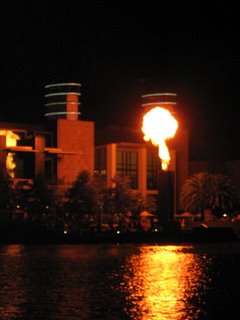


One of the other highlights of Melbourne was strolling by the riverfront at night, when they shoot giant jets of flame from sculpture/fountain like structures along the bank. The flame is so big that you can feel the heat even if you are viewing the show from across the water (as we did on the second night), It is not a very energy-efficient feature, but it is definitely an experience that we won't forget.

Wednesday, August 23, 2006

Trip Story: Porangahau

The stated purpose of our visit to Porangahau was to allow me to sample the "traditional New Zealand beach holiday." Apparently, many New Zealand families spend a week or two in a small beach town every year. I had been told about how relaxing this was, and was looking forward to experiencing it for myself. In theory, Porangahau was an excellent place to do this- it is a small town far away from the big city and has a big sandy beach. In practice, it had some flaws: no dairy (the New Zealand term for a small corner shop, which was to be our source of the ice creams I'd been told we would eat daily) and no bakery (which was to be the source of our daily meat pie lunch). In their place, there was a tackle shop that also sold the afore mentioned essentials as well as the equally essential bottles of beer. The pies were mass-produced frozen things that were reheated in a microwave and/or pie warmer and the ice cream selection was limited to prepackaged bars and cups. Neither the pies nor the ice-cream were bad, but they didn't quite live up to be pre-trip hype.

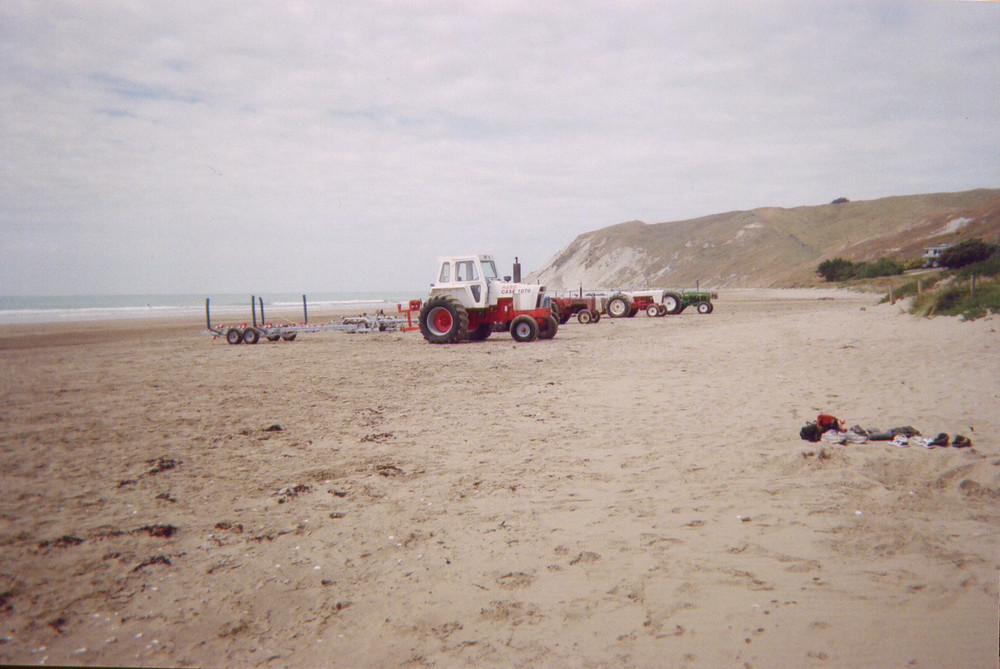
The other problem with Porangahau was the weather. It turns out that "Porangahau" roughly translates to "a big wind" (at least according to Hubby's aunt, who lives there). It certainly lived up to its name. This meant that it was usually too cold for me to consider going into the water, and often too cold for me to sit on the beach without long sleeves. To be fair, we were there a little before summer truly hit, and it is definitely a beautiful beach- long, wide, and mostly empty. You could easily find a swath to call your own and avoid any worries about anyone overhearing your conversation (not that this is usually a big worry in New Zealand; see the previous post). We did, however, have to worry about being run over by kids on bikes, both the motorized and pedal powered variety. Apparently, the large stretches of mostly empty sand are too tempting to resist. The bike-riding kids made me nervous, but we never saw anyone get run over. At least we didn't have to contend with the larger version of these toys, i.e., the tractors the locals use to tow their boats into and out of the surf. The fishermen went out long before we made it to the beach, and came back in well after we had packed up for the day. I could see the practicality of using large-wheeled tractors to tow the boats across the sand, but I still found the sight of a row of tractors parked on the beach pretty funny.

I spent quite a bit of time one day standing in the shallow water, watching little fish swim around my ankles. There were at least three different varieties, but all suffered from the same tendency to get caught by surprise when a wave receded, causing them to suddenly swim like mad back toward the deeper water, occasionally jumping out of the water in their haste. I found this hugely entertaining to watch. At one point, while chasing after the panicked fish, I realized I had gotten the true New Zealand beach holiday experience despite the sub-standard pies and limited ice cream selection. The most essential part of the New Zealand beach holiday is the long stretch of days with nothing much to do except sit on the beach, walk on the beach, or, in my case, stand in the water and watch little fish get surprised by the way receding waves make the water suddenly get shallower. Our trip to Porangahau had been a success.